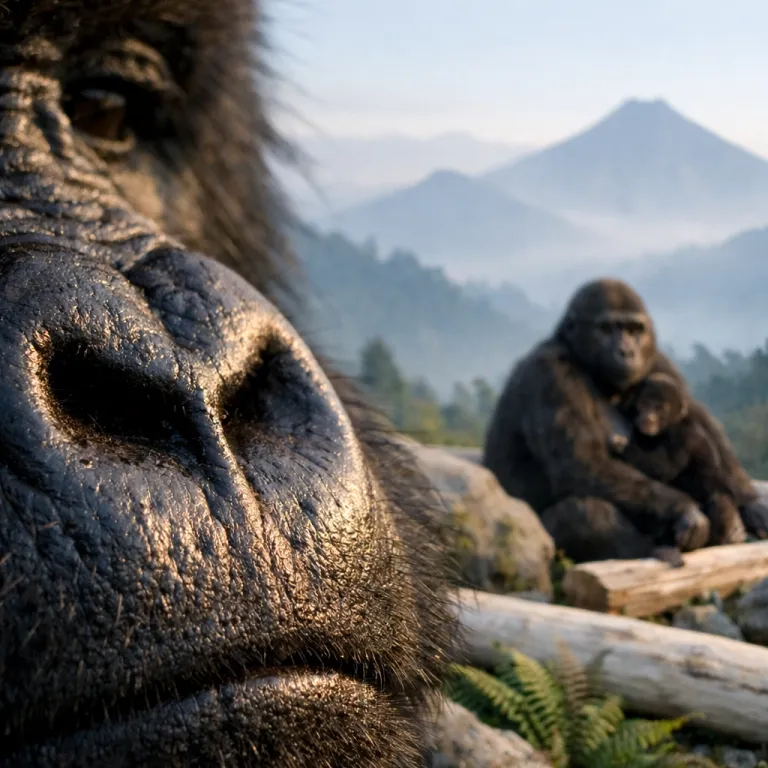
The quiet mystery of the mountain gorilla nose
In the misty forests of the Virunga massif, the mountain gorilla moves with deliberate calm. Its broad face and seemingly nose small profile hide one of the most remarkable features mountain researchers have ever relied on. To understand what is special about a mountain gorilla s nose, you must look closer at the ridges and grooves that shape its identity.
Each mountain gorilla carries a pattern of lines on the nose that is as individual as a human fingerprint. These nasal prints allow conservationists to follow gorilla groups without disturbing their natural behavior, which is essential in such a fragile habitat. The question about mountain identity is therefore answered not by collars or tags, but by the quiet geometry of gorilla noses.
Researchers first realized the unique value of the gorilla nose when they began sketching and photographing these patterns in the high forests. They noticed that the nasal passages and surrounding skin formed stable prints that did not change as the gorillas aged. This stability turned every nose mountain profile into a permanent passport for individual identification.
Today, when experts explain what is special about a mountain gorilla s nose, they highlight both its biological and conservation role. The nose role extends far beyond breathing, because it anchors long term monitoring and gorilla conservation strategies. In a region shared by Rwanda Uganda and the Democratic Republic of the Congo, such precise tracking supports cross border conservation efforts that protect the species as a whole.
From nostrils to nose prints: how experts read a gorilla face
At first glance, a mountain gorilla nose seems dominated by two wide nostrils and smooth dark skin. Look carefully, and you will see a network of fine ridges, shallow depressions, and subtle curves that form the nasal prints. These features mountain specialists examine are what is special about a mountain gorilla s nose in practical fieldwork.
Researchers and conservationists photograph each gorilla nose from several angles, ensuring that the nasal passages and surrounding textures are clearly visible. They then compare these images to existing catalogues, matching the unique patterns to a known individual or registering a new one. This method of individual identification is non invasive, respectful of gorilla groups, and highly reliable in the long term.
“Each gorilla has a distinct pattern of ridges and grooves on its nose, similar to human fingerprints.” This statement underpins the entire system of gorilla conservation based on nose prints and has transformed how experts monitor populations. “They photograph and catalog nose prints to identify and monitor individual gorillas over time.”
Because mountain gorillas live in dense vegetation, visual recognition of faces alone can be difficult when air is misty or light is low. The gorilla nose, however, offers stable reference points that remain visible in photographs even under challenging conditions. For travelers interested in refined wildlife experiences, similar attention to detail shapes curated birdwatching journeys, such as those described in this guide to refined Sri Lankan retreats for birdwatching with expert guides.
High altitude life and the respiratory role of the gorilla nose
The habitat of mountain gorillas lies in high altitude forests where air is cool, thin, and often saturated with mist. In this environment, the respiratory system must work efficiently to warm and humidify every breath. The nasal passages and external gorilla nose structure play a central respiratory role that complements their famous muscular strength.
When examining what is special about a mountain gorilla s nose, biologists emphasize these nasal adaptations to life at high elevation. The broad nostrils help regulate air flow, while internal tissues condition the air before it reaches the lungs. Such adaptations allow mountain gorillas to move across steep slopes and dense vegetation without respiratory distress, even when temperatures drop suddenly.
These aspects mountain specialists study also influence how gorillas interact within their social groups. A healthy nose role includes filtering particles from the forest air, which reduces the risk of respiratory infections spreading through gorilla groups. In turn, this supports long term gorilla conservation because disease can devastate small wild populations.
Field teams working in the Democratic Republic of the Congo and neighboring Rwanda Uganda monitor nasal health as carefully as they track nose prints. Any sign of discharge, injury, or obstruction in the noses of mountain gorillas is recorded alongside behavioral notes. For travelers drawn to remote ecosystems, similar attention to environmental detail defines immersive experiences in places like this account of an immersive safari in southern Tanzania’s wild heart.
Identity in the mist: how nose prints guide conservation efforts
In practical terms, what is special about a mountain gorilla s nose is its ability to anchor conservation efforts in precise data. Every time rangers photograph a gorilla nose, they add another entry to a growing archive of nasal prints. Over time, this archive reveals how individual gorillas move, which gorilla groups they join, and how families expand or fragment.
This level of detail allows conservationists to understand the role individual animals play in the wider population. For example, a dominant silverback with a recognizable gorilla nose pattern may lead several groups over his lifetime. Tracking his movements through nose mountain images helps experts evaluate genetic diversity and social stability in the wild.
In regions spanning the Democratic Republic of the Congo, Rwanda Uganda, and Uganda Democratic borderlands, coordinated databases of nose prints support transboundary gorilla conservation. When a mountain gorilla crosses from one national park to another, its nasal identity remains constant, even if local teams change. This continuity strengthens conservation efforts by ensuring that every individual is counted accurately, regardless of political boundaries.
For travelers, understanding this system adds depth to a trek through high forests where air hangs heavy with moisture. Guides may quietly point out how a particular mountain gorilla has been known for decades through the same nose prints. Just as coastal landscapes complement inland reserves, some itineraries combine forest trekking with serene shores, such as those highlighted for beaches in Tanzania for safari lovers seeking coastal serenity.
Field techniques: reading noses in the wild habitat
Working in steep mountain terrain demands careful methods, and the gorilla nose has shaped many of them. Teams move quietly through the habitat, maintaining respectful distances while still obtaining clear views of nostrils and nasal passages. The aim is always to balance scientific precision with minimal disturbance to mountain gorillas living their daily lives.
Photographers use long lenses to capture the fine details that make each gorilla nose unique. They focus on the area above the nostrils where prints form a complex map of ridges and shallow valleys. Back in camp, these images are compared to existing records, confirming whether the nose small variations belong to a known individual or a newly recorded one.
Because weather at high altitude can shift quickly, field teams must adapt their techniques to changing light and air conditions. Mist can soften the outlines of noses, while bright sun can create glare on the dark skin of the nose mountain profile. Experienced conservationists learn to anticipate these challenges, timing their observations to capture the clearest possible nasal prints.
Permits, expert guides, and strict regulations ensure that visitors do not interfere with this delicate work. When travelers join treks, they indirectly support gorilla conservation by funding the monitoring of gorilla groups through nose based identification. In this way, what is special about a mountain gorilla s nose becomes part of a broader story in which tourism, science, and protection are closely linked.
Planning a trek: why the gorilla nose matters to responsible travelers
For anyone planning a journey to meet mountain gorillas, understanding what is special about a mountain gorilla s nose enriches the experience. The moment you see a gorilla raise its head and flare its nostrils, you are witnessing both a respiratory adaptation and a conservation tool. That single gorilla nose carries decades of data, stories of movements, and the quiet work of many conservationists.
Responsible operators in Rwanda Uganda, Uganda Democratic regions, and the Democratic Republic of the Congo emphasize the importance of permits and group size limits. These measures protect the habitat and reduce stress on gorilla groups, allowing researchers to continue photographing noses for individual identification. When you follow guidelines on distance and time, you help maintain the calm conditions needed for accurate nasal observations.
Travelers often ask about the role individual animals play in the survival of the species. The answer lies partly in the nasal prints that distinguish one mountain gorilla from another and reveal how features mountain researchers track change over time. By supporting organizations that invest in gorilla conservation, you contribute directly to conservation efforts grounded in these detailed nose records.
As you leave the high altitude forests and return to lower landscapes, the memory of those expressive noses tends to linger. You may recall how the air felt cool and damp, how the nostrils moved as the gorilla breathed, and how the nose role extended far beyond simple anatomy. In that moment, the question about mountain identity, habitat, and survival becomes personal, carried home in every photograph and story.
Key statistics about mountain gorillas and nose print monitoring
- Estimated mountain gorilla population in the wild habitat is approximately 1000 individuals, according to recent gorilla conservation assessments.
- All monitored mountain gorillas in major parks are registered through detailed nasal prints that support long term conservation efforts.
- High altitude forest reserves in Rwanda Uganda, Uganda Democratic regions, and the Democratic Republic of the Congo host the only wild populations of mountain gorillas.
Questions travelers often ask about mountain gorilla noses
Why are mountain gorilla nose prints unique ?
Each mountain gorilla has a distinct pattern of ridges and grooves on its nose, forming nasal prints that do not change over time. These unique features mountain experts study function much like human fingerprints, allowing precise individual identification. This uniqueness is central to what is special about a mountain gorilla s nose and underpins many conservation strategies.
How do researchers use nose prints ?
Researchers photograph the gorilla nose from several angles, capturing the nostrils and surrounding nasal passages in detail. They then catalog these images and compare them with existing records to track movements, health, and social changes within gorilla groups. This process supports gorilla conservation by providing accurate data for conservation efforts across the species range.
Are nose prints used for all gorilla species ?
All gorillas possess unique nose prints, but mountain gorillas have particularly distinct patterns that are widely used in field research. In regions such as the Democratic Republic of the Congo and neighboring countries, these nasal prints are a standard tool for monitoring wild populations. This practice highlights how the nose mountain profile plays a vital role individual by individual in safeguarding the future of gorillas.